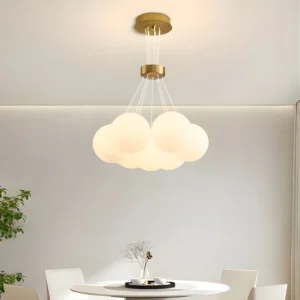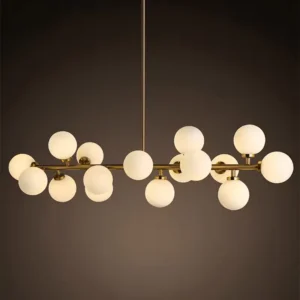
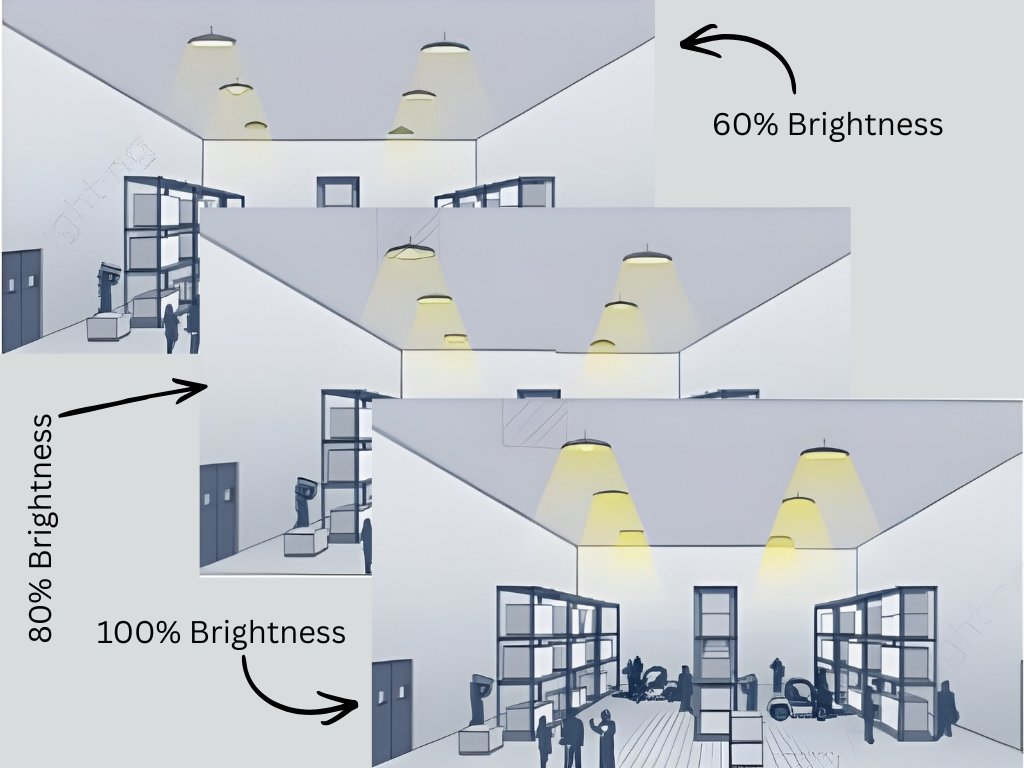
In the UAE, dimmable chandeliers with LED technology have become the standard specification for luxury villas in Dubai and Abu Dhabi, majlis rooms, hotel lobbies, high-ceiling foyers, and smart homes. The reason is practical: clients want full atmospheric control over spaces that shift function throughout the day, from bright working light to subdued evening ambiance, without replacing a single fitting.
That demand sounds simple. The execution is not. After more than a decade of designing, installing, and troubleshooting these systems across residential towers, hospitality projects, and private estates in the UAE, I can tell you that most dimming failures trace back to one root cause: incompatibility between the LED driver inside the fitting and the dimmer switch on the wall.
If you want to watch, this is an interesting and knowledgeable video on the topic
This article answers every technical question I regularly encounter from clients, contractors, and interior designers. Read it before you specify, purchase, or install.
How It All Works, Dimming, Drivers, and Compatibility
Q1: How Does an LED Chandelier Work?
A chandelier built on LED technology generates light through light-emitting diodes rather than heated filaments or gas discharge. Current passes through semiconductor material, producing photons. The LEDs themselves run on low DC voltage, typically 12V or 24V, while your UAE wall supply runs at 220–240V AC, 50Hz.
The component that bridges that gap is the LED driver. It converts mains voltage to the precise DC output the LEDs need, regulates current to prevent overdriving, and in a dimmable system, responds to signals from a dimmer switch. Driver quality is everything. In the UAE’s climate, where ambient temperatures routinely exceed 45°C, a cheap driver throttles output, shifts colour temperature, and fails prematurely. A quality driver maintains stable lumen output from 100% down to the minimum dim level without flicker.
Q2: What Makes an LED Chandelier Dimmable?
Not all chandeliers are dimmable. What makes one dimmable is a driver that accepts a control signal and modulates its output in response. Two primary dimming methods exist inside the driver:
- Pulse Width Modulation (PWM): The driver switches power to the LEDs on and off thousands of times per second. Perceived brightness drops as the off periods lengthen. At low frequencies, this causes visible flicker.
- Constant Current Reduction (CCR / Analogue Dimming): The driver reduces the actual current flowing through the LEDs. No switching. Smoother dim curve. Better colour stability at low levels.
A quality dimmable driver will also specify its compatible dimmer protocols on the datasheet. Ignoring that specification is the most common installation error I see.
Q3: How Does a Dimmer Switch Control LED Brightness?
A dimmer switch modifies the electrical signal reaching the LED driver. The driver reads that signal and adjusts its output accordingly. The control method varies by dimmer type, and the driver must be engineered to read the specific method the dimmer uses. That’s why driver-dimmer compatibility is not optional, it is the entire system.
Q4: What Types of LED Dimmers Are Used in the UAE?
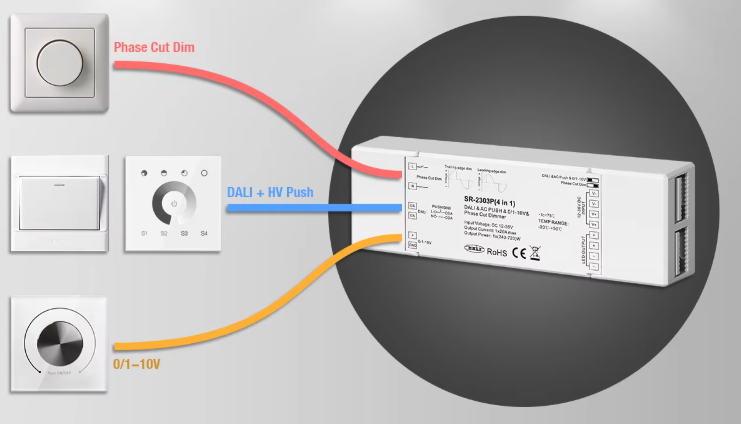
TRIAC (Phase-Cut) Dimmers
The most common dimmer type on UAE residential projects. TRIAC dimmers work by cutting portions of each AC wave cycle. Forward phase (leading-edge) dimmers cut the beginning of the wave, historically designed for resistive loads. Reverse phase (trailing-edge) dimmers cut the end of the wave and handle capacitive and electronic loads, including most LED drivers, more cleanly. Always match the dimmer type to what the driver datasheet specifies.
0–10V Dimmers
Widely used in commercial and hospitality projects across the UAE. A separate low-voltage control wire (0–10V DC) runs alongside the mains circuit. The dimmer adjusts this control voltage; the driver reads it and scales its output proportionally. Clean, stable dimming. Requires compatible drivers with a 0–10V input terminal.
DALI Systems
Digital Addressable Lighting Interface is the specification of choice for managed commercial spaces, hotel ballrooms, conference facilities, and high-end UAE smart villas. Each DALI driver has an address. The controller sends digital commands to individual fixtures or groups. Precise scene setting, feedback loops, fault reporting. Higher upfront cost, significantly more capable system.
Smart Dimmers (WiFi / Zigbee)
Increasingly common in UAE smart home projects integrating with KNX, Control4, Lutron Caseléta, or Tuya ecosystems. These dimmers communicate wirelessly with a hub. They still use a phase-cut or 0–10V output to the driver, so driver compatibility still applies. The smart layer sits above the dimming technology, not instead of it.
Q5: Why Do Some LED Chandeliers Flicker with a Dimmer?
Flicker is the most frequent complaint I troubleshoot on-site. The causes are specific:
- Driver-dimmer mismatch: The driver cannot interpret the signal the dimmer sends.
- Minimum load not met: TRIAC dimmers require a minimum connected wattage to operate correctly. Many modern fittings fall below that threshold, causing instability.
- Low PWM frequency: Cheap drivers switching at 100–200Hz produce visible flicker, especially noticeable in video recordings.
- Leading-edge dimmer on a capacitive LED driver: The mismatch causes current spikes at the start of each cycle.
- Loose wiring at the driver or dimmer terminals: Never overlook this on-site.
Fix: Confirm driver-dimmer compatibility before installation. Do not guess and adjust after.
Q6: How Do You Know if an LED Chandelier Is Compatible with a Dimmer?
Check the driver datasheet or product specification, not the product description on a retail listing. You are looking for:
- Explicit statement: “Dimmable” with protocol specified (TRIAC, 0–10V, DALI, PWM).
- Compatible dimmer brands or models listed by the manufacturer.
- Minimum and maximum load figures.
- Minimum dim level (e.g., 5% or 10%).
If none of this information is available from the supplier, treat the fitting as non-dimmable until proven otherwise.
Q7: Can You Install a Dimmer on Any Existing LED Chandelier?
No. If the installed fitting uses a non-dimmable driver, adding a dimmer switch will not produce smooth dimming. It will produce flicker, buzzing, dropout at low levels, or driver failure. The driver must be dimmable. In some retrofit situations, I have replaced internal drivers with compatible dimmable versions where the housing permits access. That is a viable approach for quality fittings, but it requires electrical work and driver sizing expertise.
Q8: What Is the Difference Between Dimming an LED and a Traditional Bulb?
An incandescent or halogen bulb dims by reducing current to a resistive filament. Lower current, lower temperature, lower lumen output. Simple physics, universally compatible with any dimmer.
Explore Guide to Common Light Bulb Types and Bases
An LED is a semiconductor device powered by a constant-current driver. The driver regulates current regardless of the input signal, unless it is specifically designed to respond to a dim control signal. No driver = no dimming. Wrong driver = problems. This is why you cannot assume that dimmer compatibility from a halogen installation carries over when retrofitting to LED.
Q9: Does Dimming an LED Chandelier Save Electricity?
Yes, with qualifications. LEDs are already highly efficient. Dimming does reduce power consumption proportionally in most quality drivers. A fitting consuming 120W at full output may draw 60–70W at 50% dim, depending on driver efficiency at partial load. Over the course of a year in a Dubai villa where lights run for extended hours, that reduction is meaningful against DEWA consumption. However, an oversized fixture running dimmed 100% of the time is not an efficiency strategy, specifying the correct wattage for the application is.
Q10: What Is the Ideal Dimmer Setup for Luxury Villas in the UAE?
For a high-end villa in Dubai or Abu Dhabi, I consistently recommend:
- Trailing-edge (reverse phase) TRIAC dimmers for individual rooms with standard chandelier circuits.
- 0–10V dimmers for large dining rooms or majlis spaces where load exceeds 500W and precision matters.
- DALI controllers for whole-home scene integration or smart home systems requiring group control.
- Lutron, Legrand, or equivalent brand dimmers with published LED compatibility lists.
Always calculate total circuit load. For a foyer chandelier drawing 200W, ensure the dimmer is rated above that figure with headroom. Most quality dimmers are rated at 200W–400W for LED loads.
Q11: What Problems Occur When the Wrong Dimmer Is Installed?
Across my projects, wrong dimmer selection produces a predictable set of failures:
- Flickering at low dim levels, particularly below 20%.
- Buzzing or humming from the driver or the chandelier body.
- Minimum dim level too high, the chandelier never reaches the desired ambiance.
- Ghost glow when the switch is off, leakage current from the dimmer circuit keeping the driver partially powered.
- Premature driver failure due to incompatible waveforms stressing driver components.
- Tripped circuit breakers from inrush current mismatches on leading-edge dimmers.
Q12: How Sparkle and Shine UAE Ensures Proper Dimmer Compatibility
Sparkle and Shine UAE operates as a specialist chandelier supplier focused on LED technology, not a general lighting retailer. Their technical team provides driver datasheets, compatible dimmer recommendations, and load calculation support as part of the specification process. For contractors and interior designers working on UAE villa or hospitality projects, that pre-purchase technical dialogue prevents the on-site problems described throughout this article. If you are specifying a fitting from them, ask for the dimmer compatibility document before the order is placed.
Q13: Can You Put a Dimmer Switch on an LED Chandelier Light?
Yes, provided the chandelier contains a dimmable driver and the dimmer switch is compatible with that driver’s protocol. The chandelier must be explicitly rated as dimmable. The dimmer must match, trailing-edge for most residential LED applications in the UAE. A standard on/off switch cannot be simply replaced with any dimmer and expected to work correctly with LED loads.
Q14: Do LEDs Work with Dimmer Switches?
Dimmable LEDs with compatible dimmable drivers work with the correct dimmer switches. Non-dimmable LEDs do not. Dimmable LEDs paired with an incompatible dimmer produce partial functionality at best, hardware failure at worst. The answer is always conditional on compatibility, never a blanket yes or no.
Q15: How Does Dimming an LED Work?
Inside a dimmable LED driver, the control input from the dimmer, whether a phase-cut signal, 0–10V analogue signal, DALI digital command, or PWM signal instructs the driver’s internal circuitry to reduce the output current delivered to the LEDs. Reduced current means fewer photons emitted, which the eye perceives as lower brightness. In PWM dimming, current stays constant but the driver switches it on and off at high frequency, creating a duty cycle that the eye averages as dimmer light.
Q16: What Happens if You Put a Dimmer on a Non-Dimmable LED?
The driver receives a signal it cannot interpret.
Common outcomes: the fitting flickers continuously, operates only at full brightness regardless of dimmer position, shuts off below a certain dim level, buzzes audibly, or the driver fails within weeks. In some cases, the incompatible waveform causes the driver to run hotter than its rated thermal limit, shortening its lifespan significantly. In the UAE climate, thermal stress on an already-marginal driver is particularly damaging.
Q17: Why Won’t the Dimmer Switch Work with LED Lights?
The most common reasons, in order of frequency from my site experience:
- Non-dimmable driver in the LED fixture.
- Leading-edge dimmer on a driver rated for trailing-edge only.
- Dimmer load rating below the total wattage of the connected LED circuit.
- Dimmer minimum load requirement not met (too few watts connected).
- Loose neutral connection at the dimmer, many older UAE installations lack a neutral at the switch position, which some modern LED dimmers require.
- Firmware or calibration issue on a smart dimmer requiring a reset.
Q18: Why Are Some Chandeliers Not Dimmable?
The manufacturer chose a non-dimmable driver to reduce production cost. Non-dimmable drivers are simpler, cheaper, and adequate for applications where dimming is not required. The physical chandelier body is identical; the driver inside is not. This is why purchasing based on appearance photographs without reading the technical specification leads to post-installation problems.
Explore Types of Chandeliers: A Comprehensive Guide
Q19: How Do I Know if My LED Light Fixture Is Dimmable?
Three reliable methods:
Check the product label or datasheet for “Dimmable” with a protocol listed.
- Locate the driver (usually inside the canopy or body of the chandelier) and read the model number. Search the manufacturer’s website for the driver datasheet.
- Contact the supplier before purchase and request written confirmation of dimmability and compatible dimmer types.
If you already own the fixture and are uncertain, a qualified electrician can test with a trailing-edge dimmer on a test circuit before committing to full installation.
Q20: What Are the Signs of an Incompatible Dimmer?
On-site indicators that the dimmer and LED driver are mismatched:
- Flickering at any dim level, particularly at the low end of the range.
- Audible buzzing from the chandelier or the dimmer plate.
- The chandelier turns off abruptly before reaching the minimum dim position.
- A ghost glow when the dimmer is at zero.
- The dimmer runs noticeably hot to the touch.
- Inconsistent behaviour between identical fixtures on the same circuit.
Any of these signs warrants investigation before assuming the chandelier is faulty. In most cases I diagnose on-site, the chandelier is fine and the dimmer is wrong.
Common Mistakes UAE Buyers Make When Choosing a Dimmer
- Buying a dimmer based on brand recognition without checking LED compatibility rating.
- Installing a leading-edge dimmer on LED drivers rated for trailing-edge only.
- Connecting a single dimmer to multiple chandelier circuits and exceeding its load rating.
- Not accounting for minimum load, a single low-wattage fitting may fall below the dimmer’s minimum threshold.
- Assuming that a dimmer that worked with halogen will work with LED replacements.
- Purchasing the fitting without confirming dimmability with the supplier in writing.
- Installing a smart dimmer without verifying neutral wire availability in the UAE switch box.
- Skipping load calculation for large foyer or majlis installations.
Final Expert Advice: What to Confirm Before You Buy
Request the driver datasheet, not just the product description. The datasheet tells you the dimming protocol, compatible dimmer types, input voltage range (confirm 220–240V UAE compliance), operating temperature range, and minimum dim level.
Match driver protocol to dimmer type before installation. If the datasheet says trailing-edge TRIAC, that is the only acceptable dimmer category for that fixture.
Calculate your total circuit load. Add up the wattage of every driver on the dimmer circuit. Keep that figure within 75% of the dimmer’s maximum LED load rating to allow thermal headroom.
In high-ambient-temperature UAE installations, especially in non-air-conditioned service areas above ceilings, confirm the driver’s maximum operating temperature. A driver rated to 40°C will fail in a UAE ceiling void.
Book our Professional Chandelier Installation Today
For smart home integration, confirm the dimmer’s output protocol before selecting drivers. The smart interface layer and the physical dimming layer must both be specified correctly.
Engage your supplier’s technical team. Suppliers like Sparkle and Shine UAE who specialise in this category can provide compatibility documentation and load calculations at the specification stage, which is far less expensive than replacing dimmers and drivers after installation.
Conclusion
These fittings deliver exceptional efficiency, longevity, and design flexibility. Dimming them correctly unlocks their full value for luxury interiors, majlis rooms, hotel lobbies, and smart villas across the UAE.
Compatibility between the LED driver and the dimmer switch is not a secondary consideration, it is the technical foundation of the entire system. Driver quality determines performance in UAE thermal conditions. Dimmer selection determines whether the system functions smoothly or fails immediately. Professional specification prevents both outcomes.
Get the datasheet. Match the protocol. Calculate the load. Source from a supplier who provides technical documentation. That process produces a properly specified dimming system that performs correctly on day one and continues performing for years.