I will never forget the client who insisted “brighter is better” and swapped every bulb in their living room to a super-cool, high-output LED. The result was not “bright and modern.” It felt like a dentist’s office at midnight. We fixed it in 20 minutes, not by buying fancier fixtures, but by choosing the right bulb type, the right base, and the right light quality.
That’s the real issue most homeowners run into: bulbs look simple, but the details matter. The common pain points I see over and over:
- Wrong base: The bulb simply won’t fit the socket.
- Wrong size: It fits, but it hits the shade or sticks out awkwardly.
- Incompatible voltage: A classic problem with low-voltage spotlight bulbs like MR16.
- Wrong “feel”: The light is too harsh, too dim, too cold, or makes your space look washed out.
This guide keeps things practical. We’ll cover common light bulb types and light bulb base types in plain English, focusing on what homeowners actually encounter in everyday fixtures.
Reading Suggestion: How to Change Chandelier Light Bulbs: A Step-by-Step Guide
How Many Types of Light Bulbs Are There?
Here’s the truth most people don’t know: when someone asks “how many types of light bulbs are there,” they could mean three different things:
- Technology (LED, incandescent, halogen, CFL)
- Shape (A-shape, globe, candle, reflector, tubular)
- Base or fitting (E27, E14, GU10, B22, G9… the part that connects to the socket)
There are hundreds of bases worldwide, and even pros still bump into unfamiliar ones occasionally. But for homeowners, the good news is simple: most homes use a small, manageable set of bulb types and bases.
Light Bulb Types by Technology
- LED: The modern default. Energy-efficient and long-lasting, with typical lifespans around 10,000 to 30,000 hours. This is why I push LED for most rooms: fewer ladder trips and fewer “why did this bulb die already?” moments.
- Incandescent: Older tech, runs hot, shorter lifespan. Still found in older homes, but the base types are the same as LEDs.
- Halogen: Brighter than incandescent and still runs warm. Often used in spotlight styles historically.
- CFL: Energy-saving but slower to warm up and increasingly unpopular.
Important practical point: Incandescent bulbs do not have “special bases.” They use the same base systems as LED bulbs. If your fixture takes E27 or B22, LED versions typically fit right in.
Common Light Bulb Shapes Explained
When you search “types of LED light bulb shape,” you’ll see a mix of household staples and decorative shapes. Think of bulb shape like the “body” of the bulb, and the base like its “shoe size.” Both matter.
Standard Household Bulb Shapes
| Base Type | Model/Code | Description | Dimension | Applications |
|---|---|---|---|---|
| Screw | E27 | Standard screw | Outer diameter ≈ 27mm | General household bulbs (living room, bedroom) |
| Screw | E14 | Small screw | Outer diameter ≈ 14mm | Decorative lamps, fridge bulbs, crystal lights |
| Screw | E40 | Industrial screw | Outer diameter ≈ 40mm | Streetlights, factory lighting, high-wattage |
| Bayonet | B22 | Standard bayonet | Base diameter ≈ 22mm | Ceiling lights, traditional home fixtures |
| Bayonet | B15 | Mini bayonet | Base diameter ≈ 15mm | Fridge lamps, night lights |
| Bi-pin | GU10 | Twist-lock bi-pin | Pin spacing ≈ 10mm | 220V spotlights |
| Bi-pin | GU5.3 | Low-voltage bi-pin | Pin spacing ≈ 5.3mm | 12V spotlights (with transformer) |
| Bi-pin | G9 | Loop bi-pin | Pin spacing ≈ 9mm | Chandeliers, wall lamps (LED) |
| Bi-pin | G4 | Micro bi-pin | Pin spacing ≈ 4mm | Cabinet lights, small bulbs (12V) |
| Fluorescent | G13 | Bi-pin for long tube | Pin spacing ≈ 13mm | T8/T10/T12 fluorescent tubes |
| Fluorescent | G5 | Bi-pin for slim tube | Pin spacing ≈ 5mm | T5 fluorescent tubes |
Bulb Models, Specialty and Shapes
Light bulbs come in a variety of shapes and each shape has a specific purpose, both in how the light spreads and how the fixture looks. Not all bulbs that fit the same base will produce the same effect in a room. Below are the most common “light bulb models” you’ll see in households, why they matter, and where they work best:
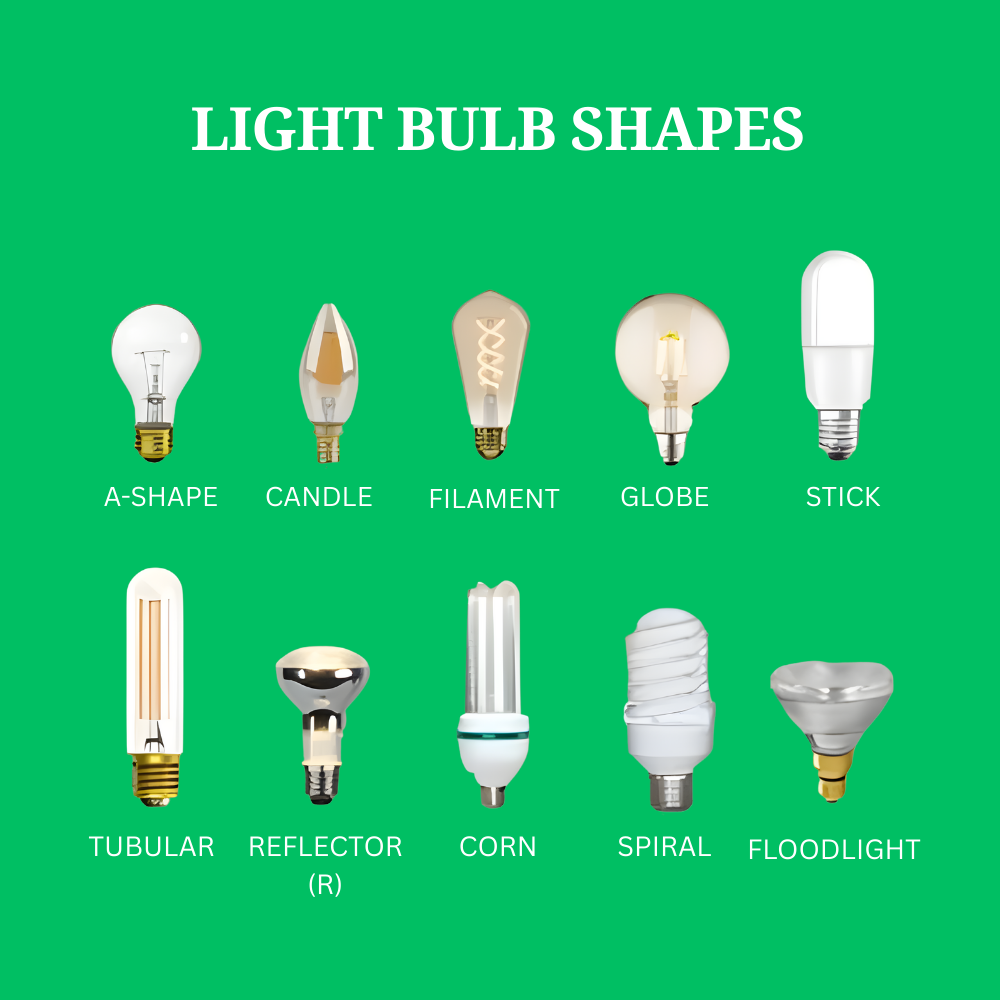
1. A-Shape (Type A)
This is the classic everyday bulb most people picture when they hear “light bulb.” I use A-shape bulbs for general lighting in living rooms, bedrooms, and table lamps because they distribute light evenly in all directions. If a fixture doesn’t demand anything special, this is usually the safest and most forgiving choice.
2. Candle
Candle bulbs are all about elegance. Their slim, flame-like profile is designed for chandeliers and wall sconces where the bulb is visible. In my experience, they work best when the goal is atmosphere rather than brightness. Think dining rooms, hallways, and decorative fixtures where mood matters.
Pro Tip: When the bulb is visible, choose a shape that complements the fixture. When it’s hidden, prioritize beam spread and brightness.
3. Filament (Vintage-Style LED)
Filament bulbs combine old-school charm with modern LED efficiency. You’ll see them in exposed fixtures, cafés, and statement pendants. I often recommend these when clients want warmth and character. Just remember, they’re meant to be seen, so they shine best without shades blocking the view.
4. Globe
Globe bulbs are round, balanced, and visually intentional. They’re a favorite for bathroom vanity lights and mirror setups because they spread light evenly across the face, reducing harsh shadows. If you’ve ever wondered why makeup lighting feels “off,” the bulb shape is often the culprit.
5. Stick
Stick bulbs are tall and slim, made for compact fixtures where space is tight. I regularly specify these for modern lamps, narrow sconces, or fixtures where a standard bulb would look bulky or won’t fit properly.
6. Tubular
Tubular bulbs are long and narrow, often used in pendant lights and decorative fittings. They create a clean, architectural look and work beautifully in modern or industrial interiors. These are great when you want light without visual clutter.
7. Reflector (R-Type)
Reflector bulbs are designed to aim light rather than scatter it. You’ll find them in recessed ceiling lights and spotlights. When someone complains that their room feels flat or poorly lit, switching to the correct reflector bulb often fixes the issue instantly.
8. Corn
Corn bulbs get their name from rows of LED chips that resemble corn kernels. These are powerhouses, commonly used where high brightness is needed, such as garages or large fixtures. They’re functional first, decorative last.
9. Spiral
Spiral bulbs are most associated with CFLs, though LED versions exist. They’re efficient but not visually appealing, which is why I usually hide them inside shades or enclosed fixtures where looks don’t matter.
10. Floodlight
Floodlight bulbs produce a wide, powerful beam. I specify these for outdoor lighting, security lights, and large indoor spaces that need broad coverage. They’re not subtle, but they’re incredibly effective when visibility is the priority.
Designer insight: Bulb shape isn’t just about fit, it’s about intent. If the bulb is visible, choose a shape that complements the fixture. If the bulb is hidden, prioritize light spread and brightness. Getting this right is one of the easiest ways to make a space feel thoughtfully designed rather than accidental.
If you have an open fixture where the bulb is visible, shape matters more than people think. A globe bulb can make a vanity look intentional, while a random A-shape can make it look like a temporary fix.
Reading Suggestion: What Kind of Light Bulbs do Chandeliers Use?
Understanding Light Bulb Base Types
This is the part that prevents the most headaches. The biggest mistake I see is homeowners buying the perfect-looking bulb, then realizing it does not fit the socket.
Why the base type is critical:
- It determines physical compatibility with the fixture.
- It’s the fastest way to avoid returns and wasted trips.
- It ties into voltage and wattage safety, especially with spotlight systems.

Edison Screw Base Types (E-Series or Light Bulb Screw Types)
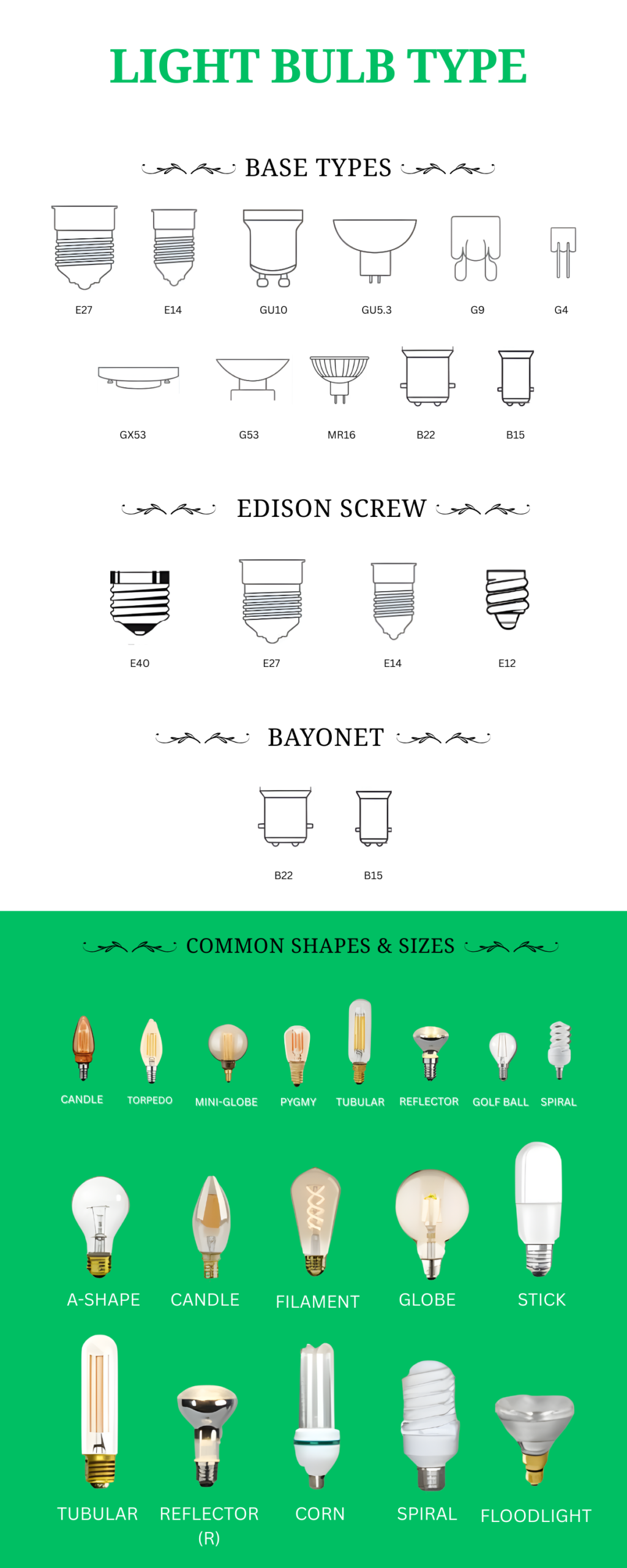
Edison screw bases are the most common “light bulb screw types.” The number roughly corresponds to the base diameter in millimeters.
E27: Large / Medium Screw
- Diameter: ≈ 27mm
- Applications: General household bulbs, living rooms, bedrooms
- Wattage range: Typically 5W to 100W+ depending on bulb and fixture
- Common shapes: A-shape, globe, reflector, floodlight styles
If you’re in North America, you’ll often see E26 instead of E27. They’re extremely close in concept (and commonly treated as the “standard household base” in their regions).
E14: Small Edison Screw
- Diameter: ≈ 14mm
- Applications: Decorative fixtures, chandeliers, fridges, wall sconces
- Wattage range: Usually 3W to 40W
- Common shapes: Candle, torpedo, mini-globe
In real homes, I think of E14 as the “cozy fixture base.” It shines in places where mood matters more than brute brightness.
E12: Candelabra Screw
- Diameter: ≈ 12mm
- Common in: North America (often 120V systems)
- Applications: Nightlights, ornamental string lighting, chandeliers
What is an E12 bulb? It’s a candelabra base bulb: tiny screw base, fine threads, compact design. It’s also frequently confused with E14. They are not the same.
Quick clarity:
- E12 is about 12mm
- E14 is about 14mm
That 2mm difference is enough to make them incompatible without an adapter.
E40: Industrial Screw
- Diameter: ≈ 40mm
- Where used: Streetlights, factory lighting, high-wattage installations
- Homeowner note: Rare in homes unless you have a specialized workshop or industrial fixture
Bayonet Light Bulb Bases (B-Series)
Bayonet bases twist and lock rather than screw in. They’re common in the UK and some international markets.
B22: Standard Bayonet
- Diameter: ≈ 22mm
- Region: Common in the UK
- Applications: Ceiling lights, traditional home fixtures
B15: Mini Bayonet
- Diameter: ≈ 15mm
- Applications: Fridge lamps, night lights
Bi-Pin and Twist-Lock Bases (G and GU Series)
These are the “bulbs with prongs” category. They’re common in spotlights, cabinet lights, and small fixtures.
GU10 (Twist-Lock Base)
- Pin spacing: ≈ 10mm
- Voltage: Typically 230/240V systems
- Applications: Recessed spotlights, track lighting, kitchens, hallways
GU10 is a homeowner favorite because it’s sturdy and easy: push in, twist, done.
GU5.3 / MR16 (Low-Voltage Bi-Pin)
- Pin spacing: ≈ 5.3mm
- Voltage: 12V, requires transformer
- Applications: Bathrooms, kitchens, wet areas
This is where many DIY swaps go wrong. If you replace a GU5.3/MR16 bulb and it flickers or doesn’t light, the culprit is often the transformer or compatibility with LED loads.
G9 (Loop Bi-Pin)
- Pin spacing: ≈ 9mm
- Applications: Wall lamps, small ceiling lights, chandeliers
G4 (Micro Bi-Pin)
- Pin spacing: ≈ 4mm
- Applications: Cabinet lights, small bulbs, accent lighting
- Often 12V, commonly transformer-based
Standard base types are regional
| Region | Preferred Base Types |
|---|---|
| Mainland China | E27, E14, GU10 |
| United States | E26, E12, GU24 |
| Europe | E27, E14, G9 |
| United Kingdom | B22, E27 |
If you’ve moved countries, imported a fancy pendant light, or bought fixtures online, you’ve probably felt this firsthand.
Common Mistakes to Avoid When Buying Light Bulbs
Here are the repeat offenders I see in real homes:
- Buying the right shape but wrong base. A candle bulb can still come in multiple base types.
- Ignoring voltage requirements, especially with GU5.3 / MR16 systems that need a transformer.
- Choosing excessive wattage for small fixtures, which can cause heat issues or glare.
- Forgetting bulb length and diameter, so it doesn’t fit under a shade or inside a recessed can.
Myth to retire: “If it screws in, it’s fine.”
Not always. The light quality can still be wrong, and low-voltage systems can still misbehave.
Step-by-step Guide to choose the Right Light Bulb
- Turn power off and remove the old bulb.
- Identify the base type.
- Thick screw: E27/E26
- Thin screw: E14/E12
- Two pins with twist: GU10
- Two thin pins: GU5.3/MR16, G4
- Loop pins: G9
- Bayonet: B22/B15
- Check voltage requirements.
- If it says 12V, expect a transformer.
- Confirm fixture rating (especially for enclosed fixtures and older fittings).
- Choose your light quality: Kelvin and CRI.
- Kelvin (color temperature) is like the wardrobe of light:
- Warm light is a cozy sweater (inviting, relaxing)
- Cool light is a crisp white shirt (clean, alert, task-focused)
- CRI (color rendering index) is how “honestly” the light shows colors. Low CRI can make food look dull and skin look flat.
- Kelvin (color temperature) is like the wardrobe of light:
- Pick the shape that suits the fixture (A-shape for general, reflector for recessed, candle for chandeliers).
- Default to LED for longevity and efficiency.
Reading Suggestion: Difference Between Warm Light and Cool Light
Future Trends in Home Lighting
- LED-only households are becoming the norm because of efficiency and lifespan.
- Smart bulbs are no longer gimmicks. The useful features are:
- Voice control
- Remote dimming
- Color changing for mood and flexibility
- Better light quality is becoming more accessible, meaning more homeowners can get that “designer lighting feel” without redesigning the whole room.
Frequently Asked Questions
How do E12 and E26 bulbs differ from each other?
In the UAE, E12 and E26 are not standard household bases, but you may encounter them in imported fixtures.
- E12 is a very small candelabra base, mostly used in North America.
- E26 is the North American version of E27 and differs slightly in diameter.
In UAE homes, the practical equivalents are:
- E14 instead of E12
- E27 instead of E26
They are not interchangeable without adapters and should not be mixed due to size and voltage differences.
Candelabra base bulbs: what are they?
Candelabra base bulbs are small, decorative bulbs used mainly in chandeliers and ornamental lighting.
In the UAE, the most common candelabra bases are:
- E14 (Small Edison Screw)
- B15 (Mini Bayonet) in some imported fittings
These bulbs are designed for ambient and decorative lighting, not high brightness, and are commonly candle-shaped or flame-shaped.
A Type B light bulb: what is it?
A Type B light bulb refers to the shape of the bulb, not the base. Type B bulbs are slim, candle-like, or torpedo-shaped and are typically used in chandeliers and wall lights.
In the UAE, Type B bulbs most commonly come with:
- E14 bases
- Occasionally B15 bayonet bases
This is a common confusion point: Type B describes the shape, while E14 or B15 describes the base.
What is an R20 light bulb base size?
An R20 bulb describes the bulb shape and diameter, not the base.
- R means reflector
- 20 refers to the bulb diameter (approximately 2.5 inches)
In the UAE, R20 bulbs typically use an E27 base and are used in:
- Recessed ceiling lights
- Accent lighting
- Small spot or directional fixtures
What is the difference between E12 and E14 bulb bases?
The key difference is size and regional usage:
- E12 has a 12mm diameter and is mainly used in North America.
- E14 has a 14mm diameter and is widely used in the UAE, Europe, and Asia.
They look similar but will not fit each other’s sockets. In UAE homes, E14 is the correct and standard choice for small decorative fixtures.
What does “E12” mean on a light bulb?
“E12” means:
- E = Edison screw
- 12 = base diameter in millimeters
However, in the UAE, E12 is uncommon. Most fixtures that appear similar will actually require E14, which is slightly larger and designed for 230–240V systems.
What is considered a standard light bulb base in the UAE?
There is no single global standard, but in the UAE the most common bases are:
- E27 for general lighting
- E14 for chandeliers and decorative lights
- GU10 for spotlights
- G9 for compact wall and ceiling fixtures
- B22 in some British-style or older fittings
Are incandescent and LED bulb bases the same?
Yes. Incandescent bulbs and LED bulbs use the same base types. Bases like E27, E14, GU10, and B22 were common long before LEDs and remain standard today. LED bulbs are simply a more energy-efficient replacement.
What are bulbs with pins instead of screw bases?
These are bi-pin or twist-lock bulbs, commonly found in modern UAE homes. Popular types include:
- GU10 – twist-lock spotlight bulbs (230–240V)
- GU5.3 / MR16 – low-voltage spotlight bulbs (12V, requires transformer)
- G9 – loop-pin bulbs for small fixtures
- G4 – micro-pin bulbs for cabinet and accent lighting
Do GU10 and GU5.3 bulbs fit the same fixtures?
No, and this is a very common mistake.
- GU10 bulbs run directly on 230–240V and twist into place.
- GU5.3 (MR16) bulbs run on 12V and require a transformer.
They are not interchangeable, even if they look similar.
Conclusion
After years of working with homeowners, one lesson always stands out: great lighting is rarely about buying the most expensive bulb or the brightest fixture, it’s about choosing the right combination of bulb type, base, and light quality for the space. Once you understand the difference between bulb shapes and bases, recognize a few common standards like E27, E14, and GU10, and respect voltage and fixture limits, lighting stops being confusing and starts feeling intuitive. When everything is matched correctly, the light fades into the background and the room simply feels right. And if you want that level of confidence without climbing ladders or second-guessing fittings, Sparkle and Shine UAE is here to help. We provide professional chandelier installation, chandelier repair, chandelier cleaning, and chandelier moving, ensuring your statement lighting looks stunning, works safely, and enhances your home exactly as it should. Reach out to Sparkle and Shine UAE today and let experienced hands take care of your lighting, beautifully and safely.