
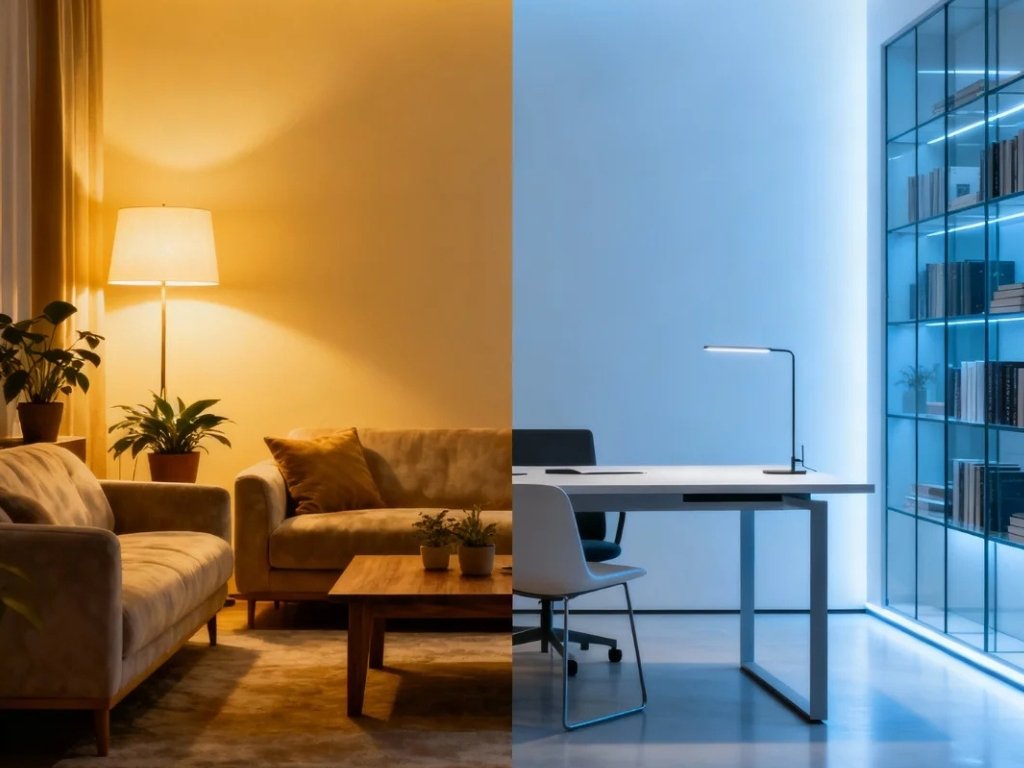
Key takeaways
- Warm light falls below 3000K and gives off an amber, candle-like glow. Cool light runs from 4000K to 6500K and looks bluish-white.
- A 2026 study in Scientific Reports measured melatonin suppression at 12.3% under cool white LED light versus 3.6% under warm white LED light, a roughly 3.4-fold difference.
- Tunable LED lamps can cut estimated melatonin suppression from about 10% at a cool 5700K setting down to 0.1% at a warm 2100K setting, according to the same study.
- Cool light increases photopic illuminance (how bright a space looks) more than warm light at equivalent wattage, which is why offices and kitchens favor it.
- Both warm and cool light are safe for the eyes at normal household exposure. The real difference is how each affects the body’s circadian signalling in the hours before sleep.
Quick answer
Warm light sits below 3000K on the Kelvin scale and produces a soft amber tone suited to relaxing spaces. Cool light runs from 4000K to 6500K, looks crisp and bluish-white, and supports focus and alertness. The choice matters most in the evening, since cool light in the hours before bed measurably suppresses melatonin more than warm light does.
What Is Color Temperature and How Is It Measured?
Color temperature describes how warm or cool a light source looks, measured in Kelvin (K), with lower numbers reading yellower and higher numbers reading bluer.
The scale comes from a physics concept called black body radiation. As a theoretical solid heats up, it glows first red, then orange and yellow, then white, and eventually blue. Lighting manufacturers borrowed that scale to describe the visual tone of a bulb rather than its actual temperature. A bulb rated 2700K produces the same amber cast as an object heated to 2700 Kelvin would glow, without the bulb itself running anywhere near that hot.
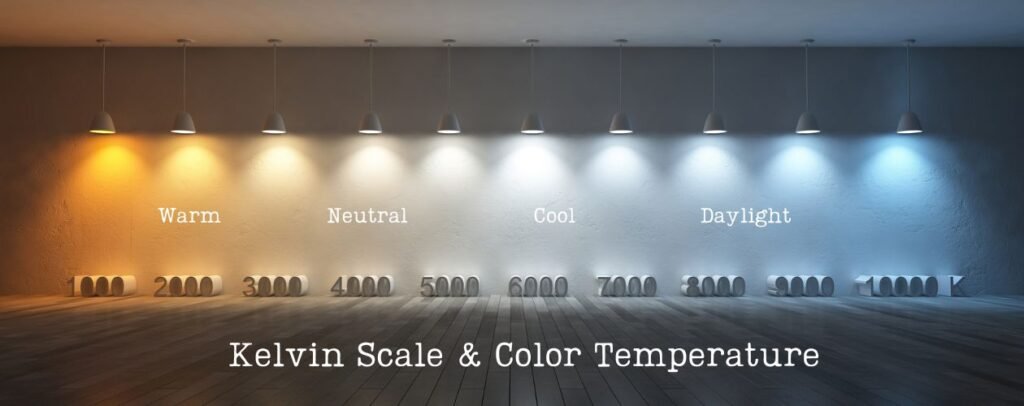
Most residential and commercial lighting falls between roughly 2000K and 6500K. Warm light sits at the low end, cool light at the high end, and a neutral middle zone around 3500K to 4000K reads as balanced white without a strong push in either direction.
Key points
- Lower Kelvin, warmer tone: 2700K to 3000K produces the amber glow associated with incandescent bulbs and candlelight.
- Higher Kelvin, cooler tone: 4000K to 6500K produces the bluish-white tone associated with daylight and office lighting.
What Does Warm Light Look Like and Where Should You Use It?
Warm light produces a soft amber or yellow glow, typically between 2700K and 3000K, and works best in spaces built for rest and connection.
Warm light comes from incandescent bulbs, halogen lamps, and LED bulbs manufactured to mimic that lower end of the Kelvin scale. It reads as cozy rather than clinical, which is why living rooms, bedrooms, and dining areas lean on it. Hospitality spaces such as restaurants and hotel lounges use warm light for the same reason: it encourages people to linger and relax rather than rush.
Tungsten and vintage Edison-style bulbs are the classic examples, producing a dim golden hue that modern LED technology now replicates at a fraction of the energy cost.
Key points
- Reduces eye strain in low light: warm tones are gentler on the eyes during evening use, which is one reason bedrooms default to this range.
- Flatters skin and furnishings: the amber cast softens skin tones and warms up wood and fabric finishes, though it can mute vivid colors and fine detail, so it is less suited to precision tasks.
What Does Cool Light Look Like and Where Should You Use It?
Cool light produces a bluish-white tone, typically between 4000K and 6500K, and suits spaces where focus and visual clarity matter more than comfort.
This end of the spectrum replicates daylight and is the default choice for offices, hospitals, classrooms, and kitchens, anywhere alertness and precision are the priority. It sharpens visual contrast, which makes reading fine print, chopping vegetables, or performing detailed work noticeably easier than under warm light. LED technology has made cool white options more efficient and consistent than older fluorescent tubes.
The tradeoff shows up at night. Extended exposure to cool, blue-enriched light in the evening interferes with the body’s melatonin production, which is covered in detail in the next section.
Key points
- Improves task visibility: cool light’s higher contrast makes it easier to spot detail, which is why it dominates workspaces and kitchens.
- Less suited to evening use: cool light’s stronger short-wavelength (blue) content is the same property that disrupts sleep signalling after dark.
How Do Warm Light and Cool Light Compare Side by Side?
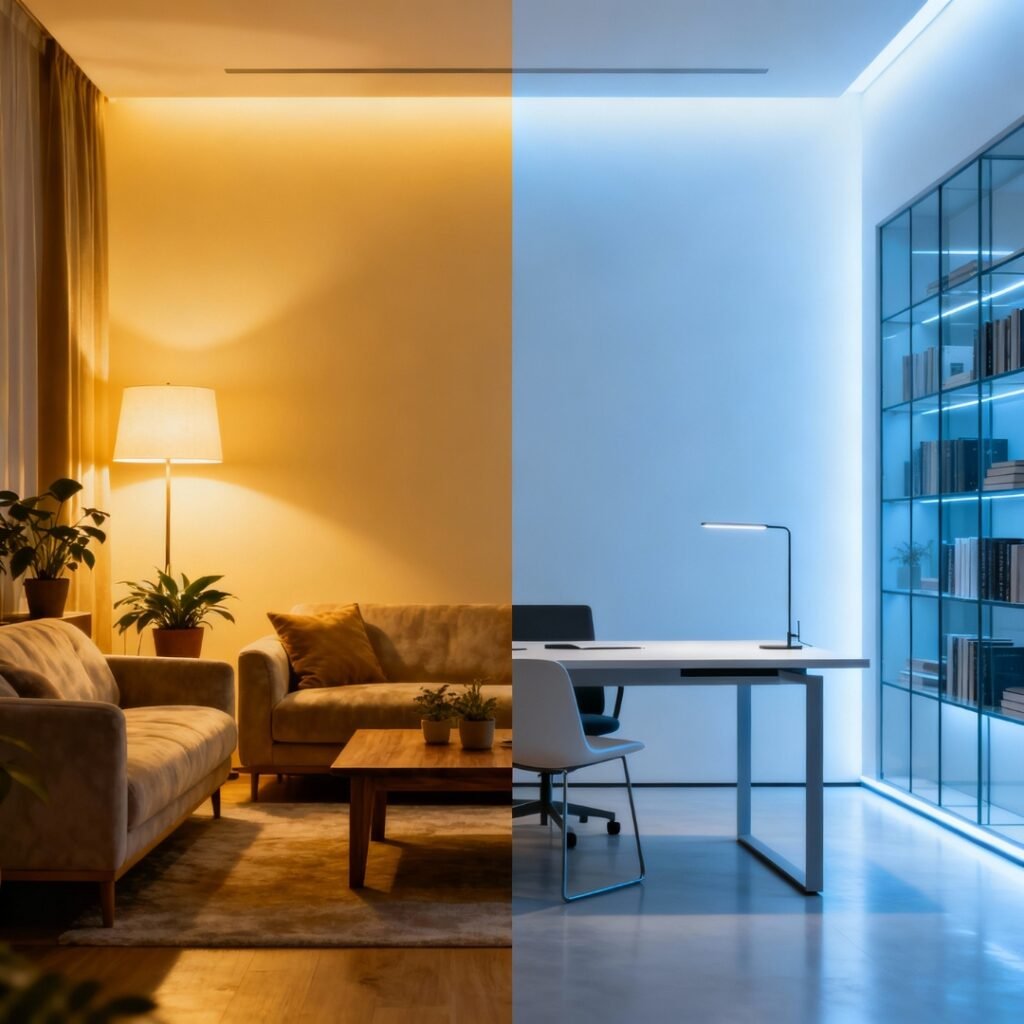
The core difference is Kelvin range and the mood each produces: warm light invites relaxation, cool light sharpens focus.
| Warm Light | Cool Light | |
|---|---|---|
| Kelvin range | 2700K to 3000K | 4000K to 6500K |
| Visual tone | Amber, yellow, orange | Bluish-white |
| Best for | Living rooms, bedrooms, dining areas, hospitality spaces | Offices, kitchens, hospitals, classrooms |
| Pairs well with | Wood, fabric, earthy finishes | Glass, steel, minimalist interiors |
| Evening use | Supports natural melatonin release | Measurably suppresses melatonin (see next section) |
| Eye comfort | Gentler in low light | Better for precision tasks, harsher at night |
Warm tones complement natural materials like wood and fabric, while cool tones bring out glass, steel, and minimalist interior finishes. From a purely functional standpoint, cool lighting suits high-clarity tasks and warm lighting suits low-stress relaxation. Which one is right depends on the purpose of the room and the mood you are aiming for, not on one being objectively better.
Does Light Color Affect Sleep, Mood and Productivity?
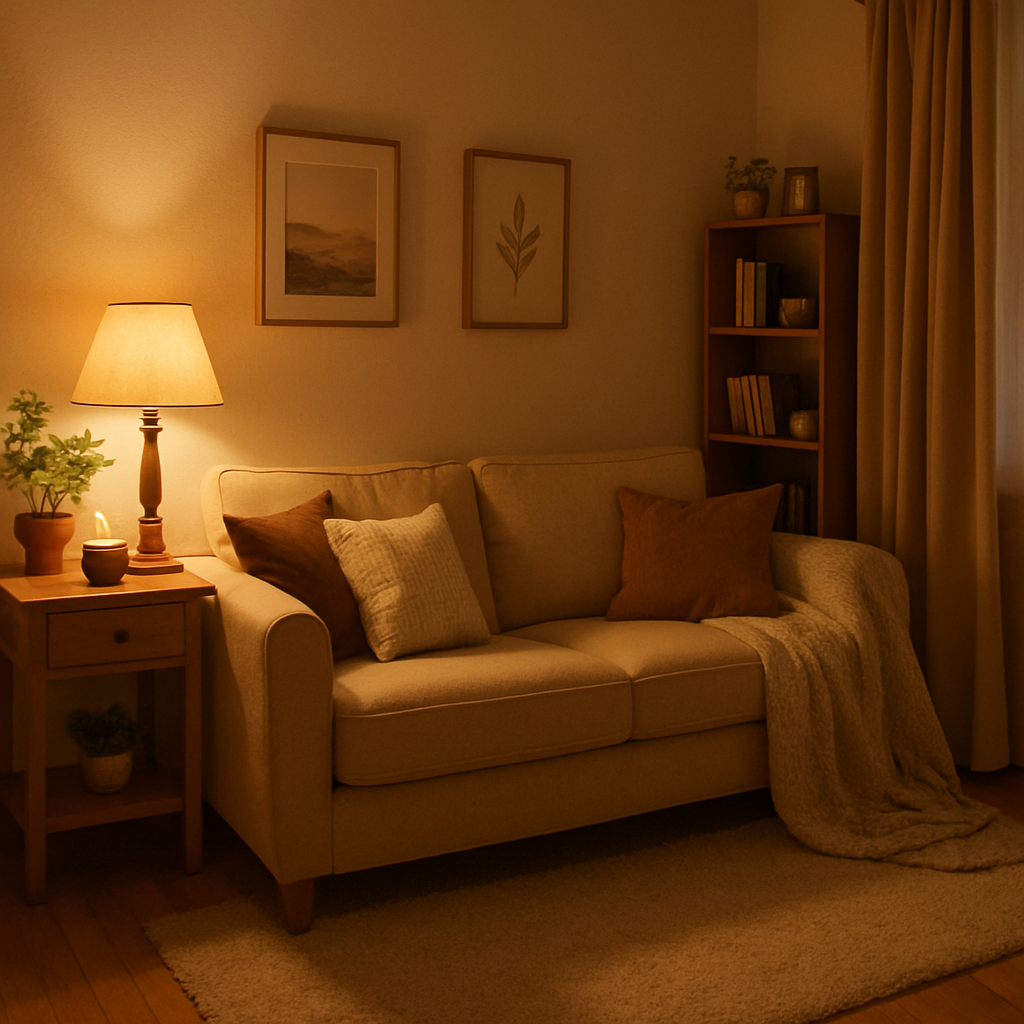
Yes. A 2026 Scientific Reports study measured cool white LED light suppressing melatonin at more than three times the rate of warm white LED light.
Researchers at the Autonomous University of Sinaloa and Harvard Medical School tested 52 household lamps across LED, incandescent, and CFL types and calculated a Melatonin Suppression Value for each. <cite index=”46-1″>Cool white LED and cool white CFL lamps induced considerably greater melatonin suppression, at a median of 12.3% and 12.1% respectively, than warm white LED (3.6%), warm white CFL (2.6%), or traditional incandescent lamps (1.5%)</cite>. The effect scales with color temperature directly: the study also found that tunable lamps could shift <cite index=”46-1″>estimated melatonin suppression from 10% at a 5700K cool white setting down to 0.1% at a 2100K warm white setting</cite>.
This matters most in the hour or two before bed. Melatonin is the hormone that signals the body it is time to wind down, and blue-enriched cool light is the wavelength range that most strongly interferes with its release. During the day, the same cool light that disrupts sleep at night can support alertness and focus, since the body responds to blue-enriched light differently depending on the time it is received.
https://www.youtube.com/results?search_query=color+temperature+kelvin+scale+explained
Key points
- Warm light before bed supports natural sleep signalling: swapping to warm, low-Kelvin bulbs in the evening avoids the sharper melatonin drop seen with cool light.
- Cool light in the morning supports alertness: the same blue-enriched wavelengths that disrupt sleep at night help wakefulness and focus earlier in the day.
Which Light Temperature Is Best for Each Room?
Match the Kelvin range to what the room is actually used for, not just its style.
- Living rooms: warm light (2700K to 3000K) supports intimacy and comfort for gatherings and downtime.
- Kitchens and bathrooms: a moderate cool tone (3500K to 4000K) improves task visibility without feeling harsh.
- Bedrooms: soft warm light (2700K or lower) supports relaxation and better sleep onset.
- Home offices and workspaces: cool light (4000K and above) supports alertness and precision during work hours.
For anyone who does not want to commit to one temperature, tunable white systems let you shift a fixture from cool to warm across the day, following the same logic the melatonin research above points to: cool earlier, warm later.
How Does Light Color Work With Interior Design?
Light color changes how materials and finishes actually read in a room, not just how bright it feels.
Warm lighting softens tones and adds richness to wood and fabric surfaces, which is why it pairs naturally with traditional or rustic interiors. Cool lighting brings out sleek, modern finishes such as glass, chrome, and polished stone. Designers typically layer ambient, accent, and task lighting rather than relying on a single fixture, and matching the color temperature of each layer to the material it lights creates a more cohesive result than picking one Kelvin value for the whole room.

Are LED Lights More Energy Efficient Regardless of Color Temperature?
Yes. LED technology outperforms incandescent and CFL lighting at both ends of the Kelvin scale, and color temperature has little bearing on efficiency.
Modern LEDs consume less energy, produce far less waste heat, and give manufacturers precise control over color temperature, whether the bulb is built to run warm or cool. Smart lighting systems now shift automatically between warm and cool gradients across the day, which lets a household follow daylight-aligned lighting without manually swapping bulbs. From an environmental standpoint, the shift away from incandescent and CFL lighting toward LED reduces both power draw and carbon footprint, independent of whether the space is lit warm or cool.
What Are the Most Common Misconceptions About Light Color?
Brightness and color temperature are two different things, and mixing them up is the most common lighting mistake.
A bulb can be extremely bright and still warm-toned, or dim and cool-toned. Brightness is a measure of lumens; color temperature is a measure of Kelvin. They are independent variables that happen to get bundled together in casual conversation about lighting.
A second misconception is that “white light” is a single, fixed color. In practice it spans a wide range, from the warm white of a 2700K bulb to the daylight-like white of a 6500K bulb, and how it reads depends heavily on the room it is used in.
A third misconception is that warm or cool light is inherently harmful to the eyes. Both are safe for normal household use. The genuine risk, based on the melatonin research above, is timing: cool light used late at night has a measurable effect on sleep hormone production that warm light does not replicate to the same degree.
Key points
- Brightness (lumens) and color temperature (Kelvin) are separate measurements, and a bulb’s Kelvin rating says nothing about how bright it will be.
- White light is not one fixed color; it spans the full Kelvin range and looks different depending on the fixture and the room.
Practical Tips for Choosing Home and Office Lighting
Before committing to bulbs for an entire space, test a few options in the room itself, since lighting reads differently once it interacts with your walls and furnishings than it does under a store’s fluorescent tubes.
- Test different Kelvin values in the actual room. Try a warm and a cool bulb side by side and see how each interacts with your existing colors and furniture before buying in bulk.
- Mix warm and cool sources deliberately. Layered lighting, warm for ambiance and cool for task areas, supports different activities without forcing one temperature to do everything.
- Follow natural daylight patterns. Use cooler light earlier in the day to support alertness, and shift to warmer light in the evening to support natural melatonin release.
- Use dimmers or tunable smart bulbs. These give you control over both brightness and Kelvin value without needing to swap fixtures room by room.
FAQ
What is an example of warm light?
Candlelight, halogen lamps, and LED bulbs rated around 2700K to 3000K are common examples. They produce a soft, yellowish glow associated with cozy, relaxed spaces such as living rooms and restaurants.
Is LED light warm or cool?
LEDs can be manufactured at either end of the Kelvin scale. Many are built to mimic the warm 2700K to 3000K range of traditional incandescent bulbs, while others are built cool at 4000K and above for task lighting.
Is warm light good for the eyes?
Yes, for general household use. Warm light is generally gentler in low-light or evening settings and produces less eye strain than cool light at night, though both are considered safe under normal exposure.
Are warm colors good for bedrooms?
Yes. Warm light around 2700K supports a calmer, more restful atmosphere and aligns with the melatonin research showing lower sleep hormone disruption compared with cool light.
What are the disadvantages of warm light?
Warm light can mute vivid colors and fine detail, making it less suited to tasks that need visual precision, and it can read as dimmer than an equivalent cool bulb even at the same lumen output.
Is warm or cool light better for the eyes at night?
Warm light is generally the gentler choice at night. Cool light’s blue-enriched wavelengths are the same ones linked to greater melatonin suppression in the evening.
Is cool light good for sleep?
No. Based on the 2026 Scientific Reports findings, cool white LED and CFL lighting produced roughly three times the melatonin suppression of warm equivalents, making it a poor choice for the hour or two before bed.
When should I use cool light?
Use cool light in workspaces, kitchens, bathrooms, and classrooms, or anywhere focus and visual clarity during the day matter more than relaxation.
What is the actual difference between warm light and cool light?
Warm light sits below 3000K with a yellow to amber hue and supports relaxation. Cool light sits between 4000K and 6500K with a bluish-white hue and supports alertness and precision.
Which light temperature is best for sleeping?
Warm light, ideally 2700K or lower, is the better choice before bed, since it produces far less melatonin suppression than cool light according to current research.
Conclusion
Choosing between warm light and cool light comes down to matching the Kelvin range to what a space is actually for. Warm light supports comfort, intimacy, and rest. Cool light supports focus, clarity, and precision. The one place the choice carries real physiological weight is the evening: the data now shows cool light measurably suppresses melatonin more than warm light does, which is reason enough to lean warm after dark regardless of what you choose for the rest of the day.
Content is Reviewed by Oliver Sabobo

I always go for warm light in my living room to create a relaxing atmosphere, but I never thought about how cool light can enhance productivity in offices or kitchens. It’s amazing how something as simple as light temperature can completely change the energy of a room!